Flash and Form: The Transfiguration’s Paradox in Medieval Images
Lecture
- Public event without registration
- Date: Jul 14, 2026
- Time: 06:00 PM - 07:30 PM (Local Time Germany)
- Speaker: Vincent Debiais
- Location: Villino Stroganoff, Via Gregoriana 22, 00187 Rome and online (Vimeo)
- Contact: rossi@biblhertz.it
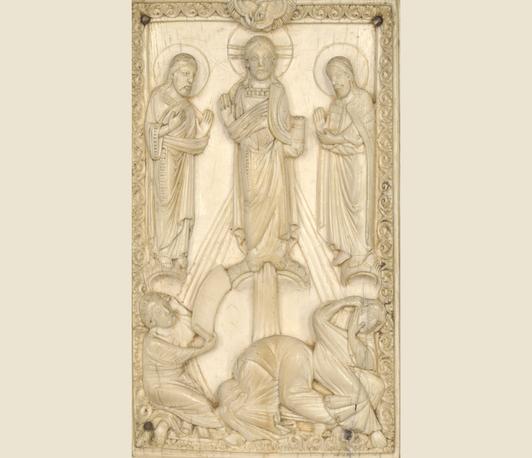
The Transfiguration on Mount Tabor constitutes one of the most powerful theophanies of the New Testament and, as such, was frequently depicted during the Middle Ages. Painted, sculpted, or mosaic images strive to capture the intensity of divine light, the whiteness of Christ’s garments, the appearance of Moses and Elijah, and the apostles’ astonishment as accounted in the Gospels. Above all, images aim to reconcile the permanence of Christ’s identity with the sudden manifestation of His divinity, thereby revealing the transitivity of human likeness. The Transfiguration raises central theological, iconographic, and theoretical questions, inviting reflection on the tension between the narrative instant and the stability of the fixed image during the Middle Ages.
Vincent Debiais (Ph.D. 2004) is a medievalist and a senior research professor at the École des hautes études en sciences sociales in Paris. His work focuses on the encounter between written culture and visual culture in the Middle Ages, and on questions of aesthetics and visual thought in medieval art. He has recently completed a book co-authored with Elina Gertsman devoted to questions of abstract thought in the visual arts of the Western Middle Ages. His new Project focuses on the medieval images of the Transfiguration. He is currently Richard Krautheimer Fellow at the Bibliotheca Hertziana – Max Planck Institute for Art History.
Please follow our event on our VIMEO platform: https://vimeo.com/event/5988137
Scientific Organization: Elisabetta Scirocco
Image: Transfiguration from the binding of the Afflighem
Gospels, 12th century (Paris, Bibliothèque de l’Arsenal, ms. 1184) ©
Gallica CC-BY-NC