Methodology Seminars for Art History in Ukraine: Art History in the Expanded Field
Lectures
- Venue: Lviv, Ukraine
- Start: Sep 28, 2026
- End: Oct 2, 2026
- Speaker: Paula Barreiro Lopez, Adrian Ivakhiv, Tristan Weddigen
- Location: Lviv, Ukraine
- Contact: mara.freiberg@biblhertz.it
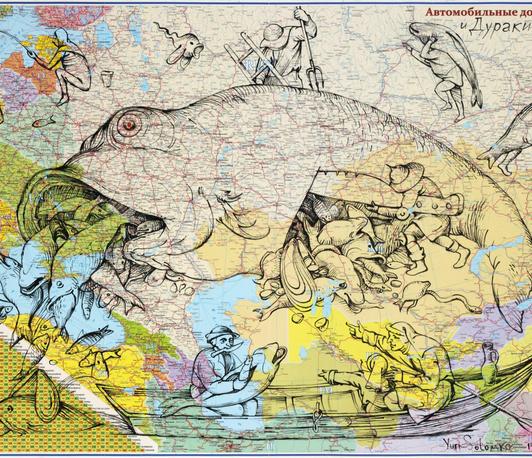
In the last week of September, the participants will gather in Lviv to present their work-in-progress and take part in a series of intense workshops with renowned scholars.
PROGRAM
Tuesday, 29 September, 18:00-19:30
Adrian Ivakhiv. “From Chornobyl to Today’s War &
Beyond: Ukraine & the Ecopolitics of War, Energy, & Climate Change”
Forty years ago, the Chornobyl nuclear
accident placed the lives of Ukrainians at grave risk from industrial
contamination. Today’s war waged by Russia places Ukrainians in a similar
situation as victims of an energy superpower’s quest to reimperialize. This
talk will argue that both events are not only connected through a long and
partly colonial relationship between Russia and Ukraine, but that they place
Ukraine into a much longer ecopolitical history that reduces land and its
traditional inhabitants to the energy resources to be extracted from it.
Today’s climate crisis is the logical end-point of that history, and its
impacts—disastrous weather events, migration pressures, and current and
foreseeable wars over remaining oil reserves, precious metals, shipping
channels, and the opening Arctic—place us all in precarious relationships with
the ground we inhabit. The Russo-Ukrainian war, I argue, is an environmental
war that is a harbinger of wars to come—which makes Ukrainians’ resistance a
source of insight for the rest of the world. What is it that makes land worth
defending? What makes ecocide also a cultural fact, and therefore also
genocidal? How is this relevant in an age of multipolar neo-imperialisms? And
how might we forge a new politics—a place-based ecopolitics of tuteishist’
(тутейшість, тутешність)—for a world beyond the present crisis?
Adrian Ivakhiv is a cultural theorist and ecophilosopher whose research and teaching are focused at the intersections of ecology, culture, identity, religion, media, philosophy, and the creative arts. Adrian Ivakhiv holds the J. S. Woodsworth Chair in the Humanities at Simon Fraser University, Vancouver, and is Professor Emeritus of Environmental Thought and Culture at the University of Vermont (UVM). At UVM (2003-2024) he was a University Scholar, Public Humanities Fellow, and Steven Rubenstein Professor for Environment and Natural Resources. He co-founded and led the EcoCultureLab, which organized collaborative engagements between ecologically oriented artists, scientists, humanists, and the broader community.
Wednesday, 30 September, 18:00-19:30
Paula Barreiro López. “Can Exhibitions Fight
Fascism? Venice 1976 and Beyond”
This lecture examines the 1976 Venice
Biennale as a key moment in the redefinition of art as a space of antifascist
resistance and democratic struggle. Focusing on the exhibition Spain: Artistic
Avant-Garde and Social Reality (1936–1976), it explores how exhibitions
construct historical narratives and challenge authoritarian cultural politics.
Moving from this historical case to the present, the lecture asks whether the
Venice Biennale can still function as a political institution in the face of
contemporary wars, the rise of authoritarianism, and ongoing debates about the
social responsibility of culture.
Paula Barreiro Lopez she is a full professor in Contemporary Art History at the Art History and Archeology Department at the Université Toulouse 2 Jean Jaurès. Currently she is head of research of the research international research platform Decentralised Modernites: Art, Politics and Counterculture in the Trasatlantic Axis during the Cold War (MoDe(s). Her research focuses on art criticism, cultural networks and politics in Spain, Western Europe and Latin America during the Cold War as well as the diverse and divergent developments of modernity reflected in the art historic accounts within an increasingly globalised world.
Thursday, 1 October, 18:00-19:30
Tristan Weddigen “Making and Unmaking -
Textility in Louise Bourgeois”
The talk explores and questions the medium- and allegedly gender-specific notion of textility that Louise Bourgeois spins across her oeuvre with reference to both classical and a personal mythology.
Tristan Weddigen joined the Bibliotheca Hertziana as a director in 2017. He received a Ph.D. from the TU Berlin with a dissertation on Raphael in 2002 and was nominated university lecturer at the University of Bern with a study on the Dresden Gemäldegalerie in the eighteenth century in 2008. He then became assistant professor at the University of Lausanne and full professor for the history of early modern art at the University of Zurich in 2009. His department focuses on the global aspects of Italian art from the early modern period to today , the materiality and mediality of art, the history of art history, and digital art history.
Scientific Organization: The project is realized with the support of the Getty Foundation, as a part of the Connecting Art Histories program, by the Bibliotheca Hertziana – Max Planck Institute for Art History in Rome and the Max Weber Foundation’s Research Centre Ukraine.
Image: Yurii Solomko, “Large Fish Eat Smaller Ones”, 2015, 107x87 cm. Courtesy of the artist.