Canaletto's Capricci: Lagoon, Antiquity, and Landscape Heritage
Research Seminar
- Public event without registration
- Datum: 12.06.2026
- Uhrzeit: 17:00 - 19:00
- Vortragende(r): Camilla Pietrabissa and Adriano Aymonino
- Ort: Villino Stroganoff, Via Gregoriana 22, 00187 Rome
- Kontakt: Editorial-LMG@biblhertz.it
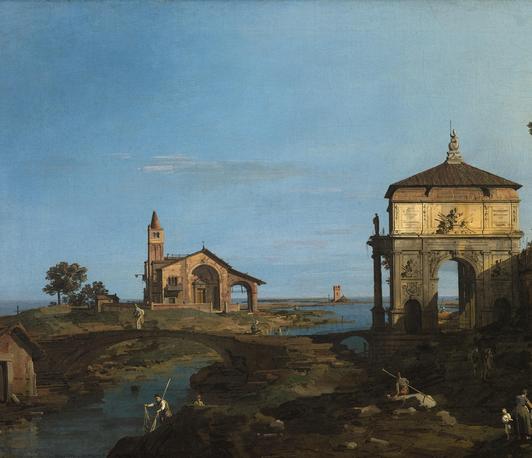
Vedute, or topographic paintings, transformed eighteenth-century Venice into the most recognizable urban center in the world, and Canaletto into the genre's most celebrated artist. Although Canaletto’s oeuvre has been largely divided into vedute and capricci, some scholars – beginning with André Corboz – have argued that the latter genre is the driving force of his entire oeuvre. From the early 1740s, Canaletto returned to paint capricci, or imaginary views of the lagoon, and he simultaneously began to approach painting experimentally. If we consider the implications of this development at the material and technical level, it becomes clear that the artist’s approach to capricci was not developed exclusively in relation to commercial interests, as it has traditionally been held.
In contrast to the preceding canon of landscape painting or to his own earlier vedute, the late capricci reveal that Canaletto found a way to connect the fluid nature of lagoon landscapes and the unstable nature of painted substances. This research seminar suggests that Canaletto’s representation of the lagoon environment as a space of alterity in his capricci was rendered on the material level by his radical experimentation with pictorial techniques. It further argues that this technical research was a strategy employed to evoke the physical qualities of the Venetian environment in pictorial form. The ‘fluidity’ of Canaletto’s paintings corresponded to the re-invention of the capricci as the natural environs of the city, considered as a space of movement and instability, if not fragility. Canaletto shows a preference for views of the lagoon lacking spatial points of reference, thus suggesting the experience of constant motion familiar to the city's visual culture.
Bringing together media studies and environmental art history, this seminar emphasizes the role of imagination in the development of a touristic visual approach to urban and landscape representation. In line with patronage studies, this approach brings tourism and mobility to the fore, considering the role of images in inducing intellectual discussion about the past, its loss and its possible reconfiguration as heritage. In presenting the environmental dimension of the capricci, I moreover hope to shed light on broader art-historical issues concerning the geography of art and the origins of a notion of landscape heritage. Eighteenth-century capricci have their origin in the early modern conception of the city as an expanding territory incorporating nature as resource and infrastructure. Ultimately, the seminar aims to illustrate landscape images as complex documents of cultural perceptions, interpretations and projections of past heritage.
Speaker: Camilla Pietrabissa, Adjunct Lecturer in Art History, Università Ca' Foscari
Venezia.
Discussant: Adriano Aymonino, senior lecturer and Director for the MA in the Art
Market and the History of Collecting, University of Buckingham.
Camilla Pietrabissa is an adjunct professor of art history at Ca’ Foscari University in Venice and a specialist on landscape painting. She has a doctoral degree from the Courtauld Institute and has been a postdoctoral fellow at IUAV University (2020–23), the Getty Research Institute (2024), the Zentralinstitut für Kunstgeschichte in Munich (2021), and the Fondazione 1563 per l’Arte e la Cultura in Turin (2019–20). Her co-edited volume Landscape Drawing in Europe 1500-1800: The Experience of Place (Paul Holberton Pubishing), containing fourteen contributions on the history and theory of landscape drawing, is now in press.
Adriano Aymonino is Senior Lecturer and Director of the MA Art Market, Provenance and the History of Collecting, University of Buckingham. His publications include Drawn from the Antique (Sir John Soane’s Museum 2015), Enlightened Eclecticism (Yale University Press 2021), winner of the 2022 William MB Berger Prize for British Art History, and a revised and amplified edition of Francis Haskell and Nicholas Penny's Taste and the Antique (3 vols, Brepols 2024).
Scientific Organization: Lise Meitner Group "Loss, and Conservation in Art History", Francesca Borgo