Elemental Ecologies: Art Histories of Situatedness and Drift from the Great Acceleration
Workshop
- Public event without registration
- Beginn: 29.10.2026 09:00
- Ende: 30.10.2026 13:00
- Vortragende(r): Workshop
- Ort: Villino Stroganoff, Via Gregoriana 22, 00187 Rome and online
- Kontakt: mara.freiberg@biblhertz.it
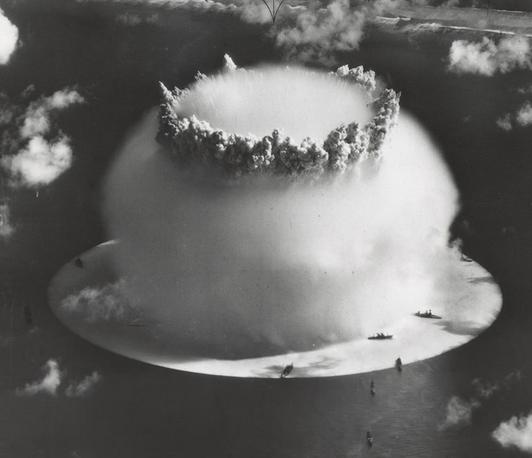
The immense diversity of the universe has often been rationalized by fragmenting it into discrete units – from the elements of the Pre-Socratics to Mendeleev’s table of atomic weights. Yet these fundamental constituents are never truly isolated; they are continuously enmeshed and reactive, repeatedly combining across time and space. Since the mid-twentieth century, human activities have accelerated this process, triggering a profound reorganization of the Earth’s matter at multiple scales and at an unprecedented pace. Vast quantities of soil and minerals are extracted and transported globally to fuel agriculture and industry, while synthetic molecules are engineered in laboratories, reformulating atoms in new ways. As a result of these monumental transformations, the composition of the atmosphere has been dramatically altered, with cascading effects on planetary cycles and regulatory systems. The environmental historians J. R. McNeill and Peter Engelke have described this epoch as ‘The Great Acceleration’ – one in which local and planetary scales are inextricably entangled, and humanity has fundamentally shaped the Earth’s geology.
The international seminar Elemental Ecologies: Art Histories of Situatedness and Drift from the Great Acceleration is concerned with how elemental transformations are manifested in visual and material culture in the second half of the twentieth century, and what art history might say about it. Under the aegis of the discipline’s so-called ‘material turn’, as well as in advancement of environmental agendas, many scholars have probed the relationships between artworks and the global circulation of goods and resources. These enquiries have proven to be very productive in engagements with early modern, nineteenth-century, and contemporary art, yet the study of works made from 1945 to around 2000 remains a relatively under-explored field.
The seminar explores what models might art historians adopt for acknowledging both the locatedness of artistic practices and their deep entanglement with planetary systems. What are the possibilities and the limits for the discipline when thinking through the earth’s elemental components? How can works of art enable us to retrace the dynamic interaction of fundamental matters across temporal and spatial frameworks? How do the material histories of drift, movement, and transformation coexist with histories of belonging and situatedness?
There are, no doubt, many viable models for narrating the ecologies of art’s constituent elements during the early decades of the Great Acceleration. This seminar will interrogate them and serve as a foundation for a future publication concerning art-historical approaches to the elemental ecologies of art produced after 1945.
Streaming on our Vimeo Channel through the following links:
October 29: https://vimeo.com/event/6232073?fl=so&fe=fs
October 30: https://vimeo.com/event/6232085?fl=so&fe=fs
PROGRAM
Thursday, 29 October 2026
09:30-10:00 Welcome
& Opening Remarks
Elisabetta
Rattalino (BHMPI), Edward
Christie (StACCS, University of St Andrews), Alistair Rider
(School of Art History, University of St Andrews)
10:00–11:20
Session 1
Chair: Giulia Beatrice (BHMPI)
10:00–10:40 Susanneh Bieber
(Texas A&M University)
Air, Water, and Atoms: Elemental
Ecologies at the 1958 World’s Fair in Brussels
10:40-11:20 Edward Christie
(University of St Andrews)
From Elemental Primitivism to Elemental
Ecologies: Agnes Denes’s Tree
Mountain and the Emerging Sustainable Development Agenda
Break
11:40-12:50 Session 2
Chair: Tobias Teutenberg (BHMPI)
11:40-12:20 Alistair Rider
(University of St Andrews)
When Wood Becomes Elemental: Three Case
Studies
12:20-13:00 Marcello Barison
(Free University of Bolzano)
Prehistoric Burri: On the Elemental
History of Aesthetic Materials
LUNCH BREAK
14:00-15:20 Session 3
Chair: Elisabetta Rattalino (BHMPI)
14:00-14:40 James Nisbet
(University of California)
Notes Towards a Genealogy of Water Art
14:40-15:20 Georgia Phillips-Amos
(University of Toronto;
University of York)
Hydroextraction in Francoist Spain
Break
15:50-17:50 Session 4
Chair: Alistair Rider (University
of St Andrews)
15:50–16:30 Millie Riddell (Courtauld)
Thinking
Big at the bottom of the world: rituals of energy and infrastructure in the
work of Andrew Drummond
16:30-17:10 Christopher Williams-Wynn
(Free University of Berlin)
Ecologies as Infrastructure: Elemental Materials and
Governmental Operations in Nancy Holt’s System Works
17:10–17:50 Andrija Filipovic
(University of Belgrade)
Alterplastics as a Method: Synthetics,
Socialist Petromodernity, and the Yugoslav Neo-Avant-Garde
Friday, 30 October 2026
09:00-10:20 Session 5
Chair: Edward Christie (University
of St Andrews)
09:00–09:40 Christian Berger (University of Siegen)
Isolated Substances, Isolated Subjects? Robert
Barry, Radioactive Isotopes, and Noble Gases
09:40-10:20 Elisabetta Rattalino
(BHMPI)
Chanting a Dioxin Cloud: the Icmesa
disaster through Paula
Claire’s Seveso (1977)
Break
10:50-10:12:10 Session 6
Chair: Diogo Rodrigues de Barros (BHMPI)
10:50-11:30 Maria Kyveli
Mavrokordopoulou (University of Amsterdam)
Porous and Toxic: Wool as Interface in
the Work of Margaret Raspé circa 1980s
11:30-12:10 Katie Anania
(University of Nebraska-Lincoln)
Decontaminating Amerika: Pesticides and
Queer Printmaking in 1980s San Francisco
12:10 - 13:00 Final Remarks.
Scientific Organization: Elisabetta Rattalino (BHMPI), Edward Christie (StACCS–the St Andrews Centre for Critical Sustainabilities, University of St Andrews), Alistair Rider (School of Art History, University of St Andrews)