Water Worlds: Early Modern Depictions of the Element Water and Aquatic Life
Research Seminar
- Public event without registration
- Datum: 25.03.2026
- Uhrzeit: 14:00 - 16:00
- Vortragende(r): Christine Göttler, Didi van Trijp
- Ort: Villino Stroganoff, Via Gregoriana 22, 00187 Rome and online
- Kontakt: katja.hackstein@biblhertz.it
Christine Göttler, Imagining World-Transformation: Rubens’s Exploration of the Forces of Water and (Raining) Fire
In the early modern period artists would have thought of the four elements and their properties with reference to Empedocles and Aristotle as the “roots” or “principal substances” of things, or as the “matter of generation” that makes up the physical world perceived by the senses; pre-Socratic philosopher Empedocles likened the elements to the few pigments used by ancient artists in ever-changing mixtures and combinations to produce seemingly living resemblances of all things. In my paper, I explore Peter Paul Rubens’s preoccupation with violent elemental forces leading to catastrophes of apocalyptic proportions. My focus will be on Rubens’s Great Landscape with a Tempest (Vienna), begun as a small panel in the 1620s, but enlarged twice and repeatedly reworked and reconceived until the 1630s. I will bring it into dialogue with his most ambitious eschatological painting, The Fall of the Damned (Munich) of about 1621. How did Rubens translate biblical and mythological accounts of universal floods and apocalyptic fires into his own medium of paint, or envision an accelerated apocalyptic time that also destroys the elements? Using Rubens’s imagery of meteorological extremes as an example, I explore the ways in which such “ultimate” forces were imagined, materialized, and staged in early modern art.
Didi van Trijp, Beneath the Surface: Picturing Aquatic Life and Lustre in Early Modern Natural History
The underwater world has long attracted the interest of naturalists, who sought to record its dazzling diversity on paper. Yet capturing the brilliance of aquatic life poses a central challenge, as colors quickly fade once organisms are removed from their element. This paper examines the visual strategies that European naturalists and their artists developed in the early modern period to address this problem. Drawing on manuscripts, printed books, and image collections, it explores how specific pictorial techniques were employed to compensate for this loss of luster. The paper further analyses the epistemic implications of these visual interventions for the observation, understanding, and representation of living nature.
Please follow the event online on our VIMEO CHANNEL: https://vimeo.com/event/5821439
Christine Göttler is professor emerita of art history at the University of Bern. She has published extensively on the intersections between the realms of art, religion, and science in the early modern period. Her most recent edited volume is Landscape and Earth in Early Modernity: Picturing Unruly Nature (Amsterdam University Press 2023). She is currently working toward completion of her book, Fluids Worlds: Art and Knowledge in Seventeenth-Century Antwerp.
Didi van Trijp is a curator and historian of science. She earned her PhD from Leiden University in 2021 with a dissertation on early modern fish books, which has been recently published with the title Fish on Paper: Ichthyology and the Disciplining of Natural History (Brill 2025). After several years working as a curator of natural history, she is now a postdoctoral researcher at Utrecht University, where she investigates the colonial heritage of universities. Her work focuses in particular on botanic gardens and anthropology collections.
Scientific Organization: Alexandre Claude and Giulia Simonini
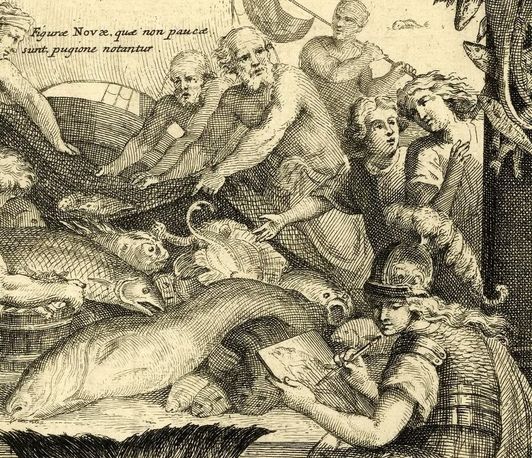
Image: Paul van Somer II, Titlepage of Icthyographia by Francis Willoughby (London, 1685), London, British Museum, 1900,1019.251 © The Trustees of the British Museum (detail)