That Mighty Lacuna! Theory and Praxis of Loss Compensation
Lecture
- Public event without registration
- Data: 02.12.2026
- Ora: 18:00 - 19:30
- Relatrice: Irma Passeri
- Luogo: Villino Stroganoff, Via Gregoriana 22, 00187 Rome
- Contatto: Editorial-LMG@biblhertz.it
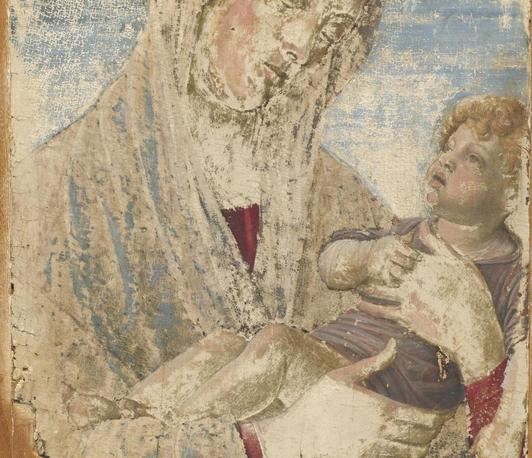
At the Twentieth International Congress of the History of Art in 1961, Philip Hendy, Cesare Brandi, and Richard Offner, offered contrasting perspectives on the aesthetic presentation and restoration of works of art. The core issue was whether it might be possible to establish theoretical principles to address artistic damage with rational, methodological approaches that avoided individualized empirical solutions. What came to the fore were considerations of the observer's experience of the work of art and the sense that a lacuna can represent a painful presence. These notions became guiding rationales for whether to restore a work of art and, if so, how to do so. The intensity of our discomfort can be proportional to both what is missing and what is put in its place.
In these discussions, damage assumed powerful yet contrasting meanings: the physical presence and perceptibility of the lacuna is feared provoking an urge to disguise it; the exposed lacuna redirects the observer's attention and enhances understanding of the original artist's qualities; the lacuna is the container of a guided and controlled imagination through the use of visible inpainting techniques that allow for a visual and physical distinction between original and restoration. In this final view, the lacuna is a receptacle of temporal space for experimentation, including ideas, thoughts, and processes. Brandi’s theory provided the clearest and most well-thought-out account, but his reception in the United States and Europe remains limited. Offner's purist approach was embraced by institutions like the Yale University Art Gallery and the Philadelphia Art Museum, with consequences that were devastating to their collections.
Here historians were playing a leading role in offering guidance
and principles for the treatment of artworks of art and thereby theoretically
avoiding the subjective solutions of restorers. However, this talk will
consider how their views of the essence of a work of art, their commitments to
visual unity during a treatment, and their notions about the way damaged works
should be perceived and presented are also subjective restoration choices.
Irma Passeri is the Susan Morse Hilles Chief Conservator at the Yale University Art Gallery. She studied painting conservation at the Scuola di Alta Formazione at the Opificio delle Pietre Dure in Florence, Italy, receiving her degree in the Conservation of Easel Paintings in 1998. She worked at the Opificio delle Pietre Dure, the Philadelphia Art Museum, and elsewhere, before becoming a member of Yale University Art Gallery conservation staff in 2000. She is a recognized specialist on tratteggio and has published articles on materials and techniques of Italian paintings and different approaches to the restoration treatment of loss compensation.
Scientific Organization:Francesca Borgo and the Lise Meitner Group