Provenance before Provenance Research. Medieval Moral Economies and the Legitimacy of Byzantine Booty in Halberstadt Cathedral after the Fourth Crusade (1204)
Research Seminar
- Public event without registration
- Datum: 17.02.2026
- Uhrzeit: 11:00 - 12:30
- Vortragende: Isabelle Dolezalek
- Ort: Villino Stroganoff, Via Gregoriana 22, 00187 Rome
- Kontakt: raffaele.rossi@biblhertz.it
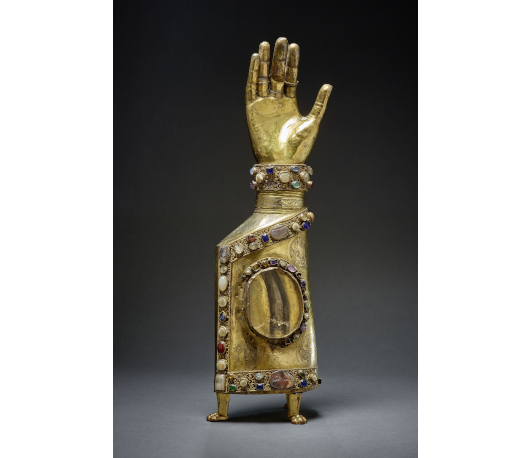
The research seminar aims to discuss approaches to the application of methods derived from modern-day provenance research to medieval subjects. Provenance research is a thriving art-historical field, which traces an object’s origins, its changes of location, and the circumstances in which these changes took place. Provenance research also embraces multiple perspectives on object translocation, taking into account both their appropriation and loss. It sheds light on the changeability of object narratives over time, on the function of objects in shaping cultural identities, and serves as a tool for analyzing shifting global dynamics of power. While provenance research has mostly been concerned with the modern era translocation of objects, this seminar seeks to assess the benefits that its methods may hold for the study and interpretation of premodern objects and material culture. The case study focuses on the cathedral treasury of Halberstadt, which was significantly enlarged after the sack of Constantinople in 1204. Bishop Konrad von Krosigk, a member of the crusading party, returned to his bishopric with a number of valuables – mainly relics, but also significant amounts of gold, silver, textiles, and other precious wares. The talk examines how such objects were acquired, received, and integrated into the cathedral treasury, and to what extent their appropriation may reflect broader medieval notions of legitimacy concerning the acquisition of material culture.
The seminar draws on research carried out within the
framework of the DFG-funded project Premodern Provenance. Tracing, Telling and
Imagining the Origins of Objects and Materials in the Medieval Mediterranean
(TU Berlin, 2025–2027.)
Isabelle Dolezalek holds the Chair of Premodern Art History at the Technische Universität Berlin. Research interests include the circulation of art and material culture in the medieval Mediterranean, as well as perceptions and narratives of provenance in medieval art.
Scientific Organization: Adrian Bremenkamp
Image: Reliquary of Saint Nicholas, ca. 1225,
from the treasury of Halberstadt Cathedral. Kulturstiftung Sachsen-Anhalt /
punctum Betram Kober (CC BY-NC-SA)